
VJTool
My VJ set still needs me at every switch, all night long
You perform with Resolume, Modul8 or VDMX, and you've hit the limits of a fixed tool: if a feature isn't there, you can't add it. On a long night it still needs you at every switch. You want your own tool that grows with you and can carry the night on its own, without dropping the setup you rely on.
- Structure:
- 5 modules, 19 lessons
- Video:
- 13 h in total
- Pace:
- All lessons open
- Access:
- 2 years
- Language:
- English
- Level:
- Intermediate
About the course
Aboutthecourse
- 01
the starting point
This course is for VJs who already work in Resolume, Modul8 or VDMX and have hit the limits of a fixed tool. You build your own VJ tool in TouchDesigner, block by block: video players, a movie bin with crossfades and drag and drop, sound analysis, signal routing, a GLSL effects selector, a custom interface and a step sequencer with presets and a Premiere EDL cue player.
- 02
what you build
You connect it to Resolume and control Resolume from TouchDesigner, so your current setup stays in use. The course ends with a walkthrough of my automatic VJ system, built for a 17-hour club night: clock dividers and sound analysis switch layers and effects, so it can carry a long night on its own without repetition.
Courseaims
- 01
To provide an understanding of how a VJ system in TouchDesigner is built from swappable blocks, how sound analysis and clock dividers drive its visuals, and how such a system can carry a long night on its own.
- 02
To develop practical skills in building a VJ tool in TouchDesigner: a movie bin, a sound analyser and signal router, GLSL effects, a custom UI, a step sequencer with presets and EDL cueing, and in connecting it to Resolume over OSC.
- TouchDesigner foundations ·
- Sound-Reactive Systems ·
- Media Playback & Movie Bin ·
- System & UI ·
- Sequencing & EDL ·
Who this course is for
For you if
- VJs — You have already hit the limits of a fixed tool, and this intermediate course starts from there without asking you to give up your current setup.
- Live visual performers — The course is pitched at an intermediate level, so it starts from what you already know of TouchDesigner instead of going back to the first node.
- Club and festival visualists — The course is for the moment a fixed tool stops being enough for a long club night, and your Resolume setup stays in use alongside it.
Not for you if
- –you do not meet the requirements in “Before you start”
- –you have neither taken TouchDesigner 101: Extreme I and TouchDesigner 102: Extreme II nor gained equivalent experience
Before you start
Completion of TouchDesigner 101: Extreme I and TouchDesigner 102: Extreme II, or an equivalent working knowledge of basic TOP/CHOP workflow, audio analysis, Container COMP layout, GLSL implementation, and Table DAT manipulation.
Prerequisites:TouchDesigner 101: Extreme I↗, TouchDesigner 102: Extreme II↗
Not taken them yet? Both are in theTouchDesigner Extreme Bundle↗.
- 01Build a movie player and a Resolume-style movie bin in TouchDesigner, with crossfades between clips and drag-and-drop clip management.
- 02Build a three-range sound analyser with triggers and a signal router with clock dividers that drives effects in time with the music, and see how a finished installation runs a long show on them.
- 03Port ShaderToy effects into a selectable GLSL effect library and build a table-driven slider interface that sound can modulate.
- 04Control Resolume from TouchDesigner over OSC with a clip selector and a 16-step sequencer with presets, and cue video from a Premiere EDL.
Programme
01TouchDesigner foundations
4 videos · 3 h 4 min
Lesson 1. Understanding nodes, parameters, and TOP/CHOP data · 56 min
In this lesson we get oriented in TouchDesigner as a node-based, real-time environment: how nodes of different families take data in and pass it on, how to read and set their parameters, and how texture and channel data are structured. We also tour the transport bar, menus and pane layouts.
Lesson 2. CHOP Basics for Audio-Reactive Control · 57 min
In this lesson we make the volume of a microphone fade a video between colour and monochrome. We turn raw sound into a control value, then send it to the image parameter in three ways: an export by channel order or name, a reference expression, and an export by path. We compare when each one fits.
Lesson 3. Modular VJ System Design · 44 min
In this lesson we package a sound-analysis network into one reusable component with its own input, output and control parameter, and drive that control from a slider linked in both directions. We also sketch the architecture of an automated VJ system: sources, mixer, sound analysis, effects and output.
Lesson 4. Controlling Movie File In playback; Building a dual-screen Perform output · 27 min
In this lesson we learn to control how a movie plays: looping, timeline sync and frame-exact indexing, the codecs that allow it, and alpha stored inside a movie. We then lay out one window across a control screen and a projector output, run it in perform mode and meet TouchPlayer.
02Sound-Reactive Systems
4 videos · 2 h 14 min
Lesson 5. Sound Analyser: Triggers · 38 min
In this lesson we start a sound-reactive VJ system: a colour-coded spectrum shows where sound events happen, a filter isolates the kick drum, and a Trigger CHOP turns it into clean pulses that a tempo-based delay keeps free of bass-line hits. We also answer chat questions on programming languages and on connecting TouchDesigner with Resolume.
Lesson 6. Sound Analyser: Interface · 32 min
In this lesson we build the control panel for one frequency range of the sound analyser, so you set it by eye: a cutoff slider over the spectrum, a threshold slider over a live volume graph, a filter-type selector and a roll-off slider. We also answer chat questions on the palette audio analyser and on analysing broken-beat music.
Lesson 7. Three-band audio analyzer; Project-wide local variables · 24 min
In this lesson we finish the sound analyser as a reusable tool: each range outputs its level, trigger and trigger count, a square flashes on every trigger, and three copies with different settings run side by side. Local variables then make the analyser reachable from anywhere in the project and set one output resolution for everything.
Lesson 8. Building an audio-control router; Divided trigger clocks · 39 min
In this lesson we build a router between the sound analyser and the rest of a VJ patch: four effect channels, each with a selectable signal source, a slider for how long triggers last, and clock dividers that turn triggers into slower triggers and counters, with one reset button. Along the way we meet Python expressions for reading table cells.
03Media Playback & Movie Bin
4 videos · 2 h 24 min
Lesson 9. Controlling Resolume clip playback with OSC · 22 min
In this lesson we use TouchDesigner as a remote control for Resolume. We build a clip selector whose button names come from a table, and each click triggers the matching clip over OSC. We then bring three Resolume layers back as separate NDI streams and look at the timing Resolume reports back.
Lesson 10. Resolume-Inspired Movie Bin: Replicator · 49 min
In this lesson we start building a Resolume-style movie bin. A folder of clips becomes a grid of preview buttons that a Replicator generates for us. Each button plays its movie once, timed to the clip's own length, and a click selects one clip and starts it.
Lesson 11. Movie Bin: Blending Between Clips · 29 min
In this lesson we make clip changes in the movie bin look intentional. The new clip crossfades in over the previous one, and the previous clip stops when the fade ends. We choose between looping a clip and replaying it on every click, and build a simpler selector without a crossfade for when you do not need one.
Lesson 12. Movie Bin: Drag and Drop · 45 min
In this lesson we build a movie bin that you fill by dragging movie files onto it. A dropped file goes into its own slot, and a drop on empty space adds a new slot. We then add buttons to clear or delete a slot, a scroll bar for long bins, and drag-and-drop reordering of the slots.
04System & UI
3 videos · 2 h 7 min
Lesson 13. FX Selector with 2D GLSL and Shadertoy Porting · 44 min
In this lesson we learn to write small 2D GLSL shaders and to use ready-made ones from the internet in TouchDesigner: we generate a gradient and stripes, control them from outside the shader, and port ShaderToy effects. Then we collect the converted shaders into one library with a selector that builds its own menu.
Lesson 14. VJ System Structure: Table-Driven UI · 44 min
In this lesson we see how a VJ system is divided into swappable blocks, loaders, mixer, effects and output, that find each other by name instead of by wires. Then we start a slider widget generated from a table of names, ranges and defaults, with a Python script that sets each slider's range and default.
Lesson 15. Building replicable sound-reactive sliders with modulation · 38 min
In this lesson we add sound to the slider widget: a menu picks which sound-analyser signal modulates it, and four modes combine it with the slider value: none, add, subtract or multiply. A green bar behind the slider shows the result, and four sliders are generated from the table. We end by keeping the channels in step and answer why.
05Sequencing & EDL
4 videos · 3 h 4 min
Lesson 16. Building a 16-step clip sequencer; Triggering Resolume clips with OSC · 63 min
In this lesson we build a 16-step sequencer that chooses which clip plays on each clock tick. It has step sliders with the current step lit, a step-rate selector and a loop-length selector. The sequencer then triggers Resolume clips and sets layer opacity over OSC. A chat question on why Resolume is used is answered.
Lesson 17. Saving and recalling sequencer presets · 20 min
In this lesson we give the sequencer presets, so one click brings back all slider positions and the loop length. A save button stores the current values in a table of presets, and a preset selector restores them, skipping presets that were never saved. We then arrange both controls in the sequencer panel.
Lesson 18. Parsing EDL cue lists for Timer CHOP playback · 67 min
In this lesson we turn a Premiere cut list into cues that play any part of one long movie. We export the EDL, parse it with Python into a table of start times and lengths, and learn timed playback with serial and parallel segments and a fade. A radio button picks the cue to play.
Lesson 19. Inside the VJ Tool · 34 min
In this lesson we look inside two complete tools: a VJ mixer with an interface and a standalone installation without one. We see what they share: one template for all shaders, layered media mixed as foreground and background, and parameters driven by sound and clock dividers. The installation adds a long movie cued from an EDL and animated 3D lighting.
After this course
Bundles and learning paths with this course
How the course works
The course is recorded and you take it at your own pace.
Every lesson is open from the first day. We recommend taking one lesson a week: it keeps a steady rhythm.
13 h in total
5 modules, 19 lessons
All lessons open
Price and what's included
205 VJTool
- Access to all video recordings for 730 days
- The project files used in the lessons
What you get
- Access to all video recordings for 730 days
- The project files used in the lessons
Payment
The price is final and the same for everyone. It includes German VAT (19%). Buyers outside the EU and EU businesses with a valid VAT ID pay the same price; their invoice shows no VAT (reverse charge).
You can pay by card (Stripe), PayPal or bank transfer.
FAQ
01How long will I have access to the lessons?
730 days. If you need more time, write to us and we extend it.
02Why pay for the course if there are free tutorials on YouTube?
YouTube tutorials are made to teach one specific technique, usually without a system or a methodology. We teach you to understand systematically how the logic of node architecture works, with a balance between a practical and an academic approach.
03I work on a Mac. Will the course work for me?
Yes. More on requirements — see "What computer and software do I need?".
04What computer and software do I need?
Windows is more efficient for this work; a Mac works too, but with limits from 3D drivers and some Nvidia-only TouchDesigner operators. TouchDesigner 2023 or later: Windows 10/11 or macOS 13+ (Apple Silicon recommended); a GPU with Vulkan 1.1 and at least 4 GB of video memory, 8 GB or more recommended. Resolume: Windows 10/11 with an Nvidia or AMD graphics card, or macOS 13.4 or later; 8 GB of RAM minimum, 16 GB recommended.
05Is the free version of the software enough?
TouchDesigner Non-Commercial is enough for the whole course, with the limits of the free licence.
06Is there a discount on software licences?
Students of the course get TouchDesigner Commercial for $400 instead of $600.
07Is there code in the course?
A little: about 2.7 h of 12.9 h. The Movie Bin lesson uses Python for drag and drop and for generating UI elements; one lesson introduces GLSL shaders and porting effects from Shadertoy; parsing an EDL cue list with Python is an optional technique you can skip. You mostly adapt ready-made code.
08Do you issue a certificate?
We don't issue certificates. What you take away is experience and the project files, and if you do all the assignments, a portfolio of your own works.
09Can I get an invoice for my employer or company?
Yes, we issue invoices to companies. Write to us before you pay.
10Are there subtitles?
Yes, every lesson has subtitles.
11How much time will the course take?
About 33–39 hours including practice: the course has 13 h of video, and each hour of video takes 2.5–3 hours to watch, rewatch and do the assignments.
12Are project files included?
Yes, every course comes with its project files.
Didn't find your answer, or not sure the course fits you?
Telegram: https://t.me/prcdrl or write to support in your GetCourse account.
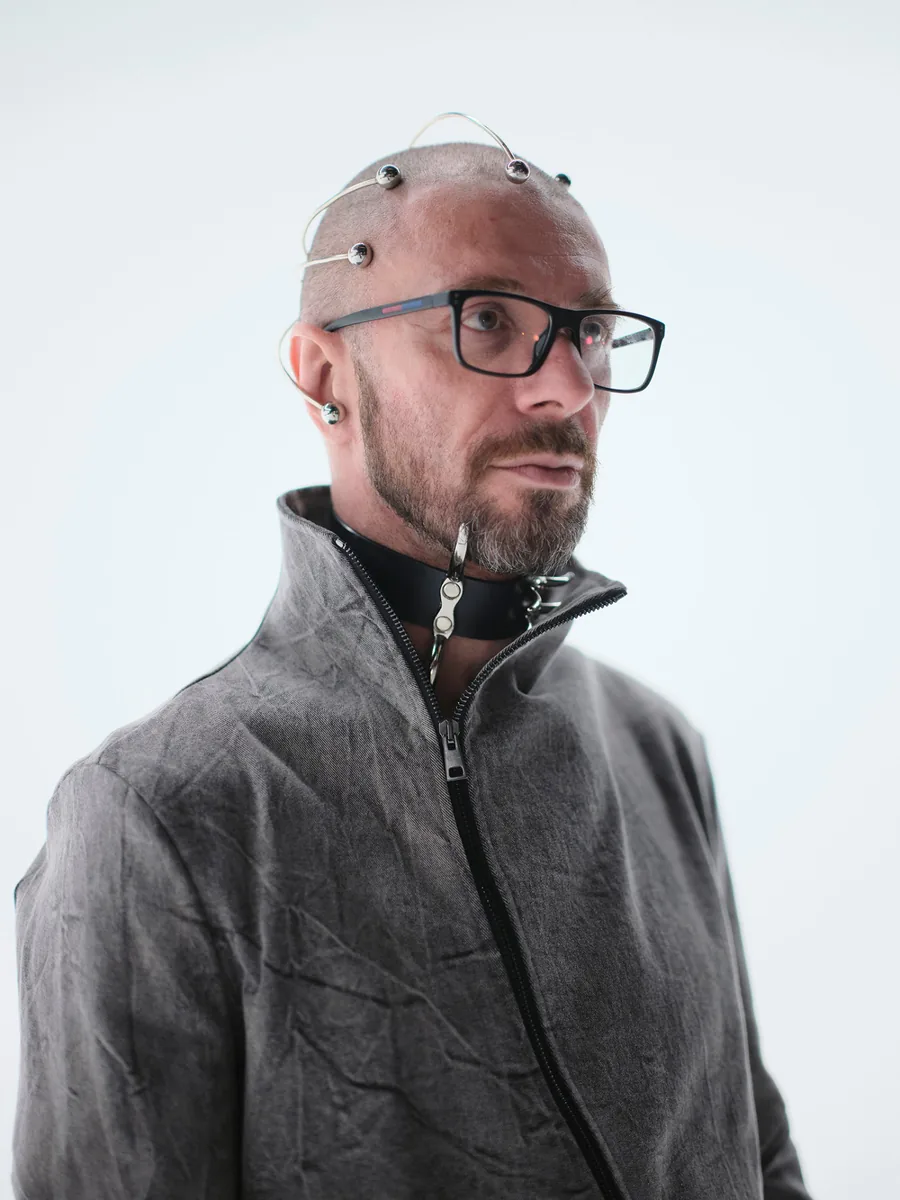
Stanislav Glazov
Media artist, technical director, founder of Hou2Touch
Stanislav started in computer graphics in 1998 with commercials and music videos, and has been teaching since 2001: Maya at RealTime School in Moscow and at SAE Institute in Munich, Houdini at Scream School, CG Event and the British Higher School of Art and Design (2008–2012). In 2009 he launched his own Houdini school, houdini-howto.com, and in 2014 he began teaching TouchDesigner. He was a character and VFX technical director on animated features at Caligari Film, Trixter and Scanline, working on rigging, cloth and hair pipelines, simulation and Maya API development. In 2010 he built the Houdini infographics pipeline for Kommersant TV, then moved into real-time visuals: video mapping at SILA SVETA and Visuals.108 (2011–2013) and, from 2013 to 2019, his own studio Licht.Pfad. He made the first Hou2Touch course in 2020 and built the school as a team in 2022. More than 2,000 people have studied with him.
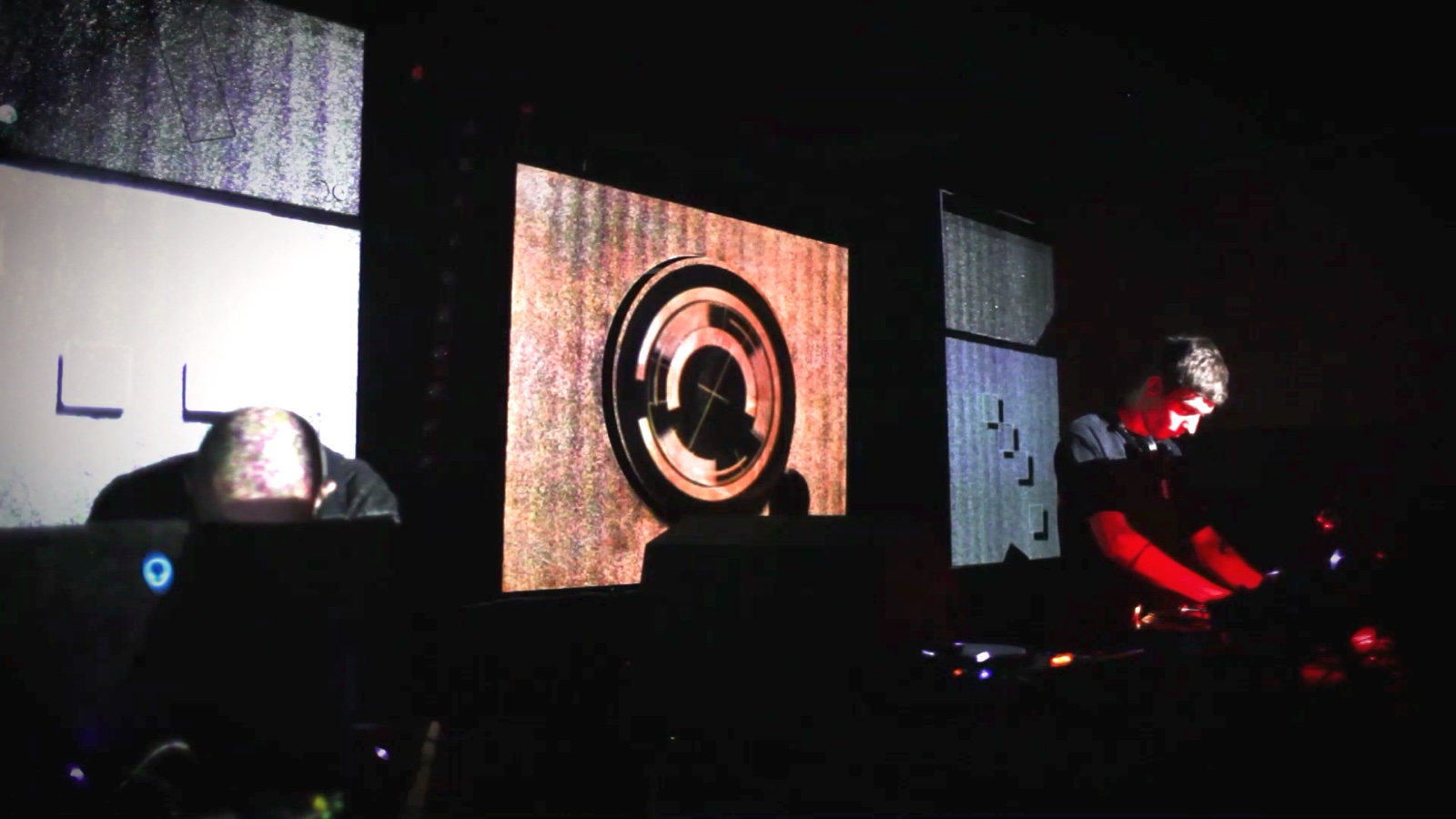
AUTOVJ Machine, his own automatic VJ system (Tresor Berlin, 2020).
In spring 2020 he wrote his own AV streaming system: multi-camera switching and sound-reactive generative post-processing.
Shown at: Berlin Atonal · Ars Electronica · Mutek Montreal · Barbican · Berghain · Fête des Lumières Lyon · Unsound · Sonar Istanbul · L.E.V.
Worked with: Maxim Didenko · Berlin Ballet Company · Dasha Rush · Robert Lippok · Whitevoid
Companies and clients: Scanline · Trixter · SILA SVETA · Hyundai
Taught at: SAE Institute · Scream School · British Higher School of Art and Design · LPM Rome
Selected projects
selected festivals & venues
The courses were detailed and provided some excellent examples and techniques that are difficult to find examples of elsewhere. You are definitely a world leading expert in TD.
The courses are great and are the best TD course's I've ever found. The use of a univeristy lesson plan approach coud help the structure of the courses (i.e. defined learning outcomes, overview of example aims, slightly more defined goals etc). I'm happy to help with some of the video production (i.e. RX7) or academic pedagogic approaches (i.e. learning outcome authorship) if needed. I have over 20 years of experience in the music industry and lecturing degree content, having designed 6 undergraduate and two postgraduate degree courses. I'm often in Berlin if you wan to chat!
You have always been very informative and have approached topics in a way that even most novice TD/Shader coders can get value from.
deep in researching and excellent approaches from point of view of proceduralism
all the topics are super, i cover by long my expectatives even push me to learn and achieve new objetives
Deep know how
205 VJTool
- Access to all video recordings for 730 days
- The project files used in the lessons
Not taken TouchDesigner 101: Extreme I and TouchDesigner 102: Extreme II yet? Both are in the TouchDesigner Extreme Bundle.
Learning Paths & Courses
Related courses and learning paths.
- extreme101beginner
 TouchDesigner101 Extreme I
Learn TouchDesigner from scratch: compositing, feedback, sound-reactive visuals, a custom movie player, machine sync and basic 3D scenes.
12 h video · €255
- extreme102intermediate
 TouchDesigner · Ableton Live +1102 Extreme II
Learn TouchDesigner procedural geometry: procedural SOP modelling, GPU instancing, real-time rendering, and Kinect, physics and Ableton integration.
11 h video · €380
- vj205current
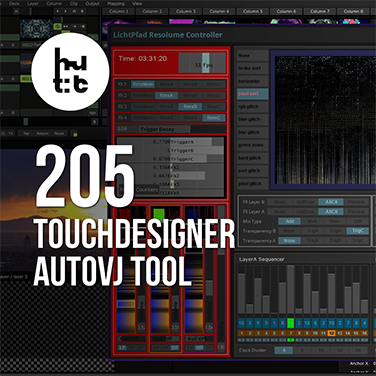 TouchDesigner · Resolume205 VJTool
Build your own sound-reactive VJ tool in TouchDesigner, with a movie bin, GLSL effects and a step sequencer, that also controls Resolume.
13 h video · €580
- path_vj1path
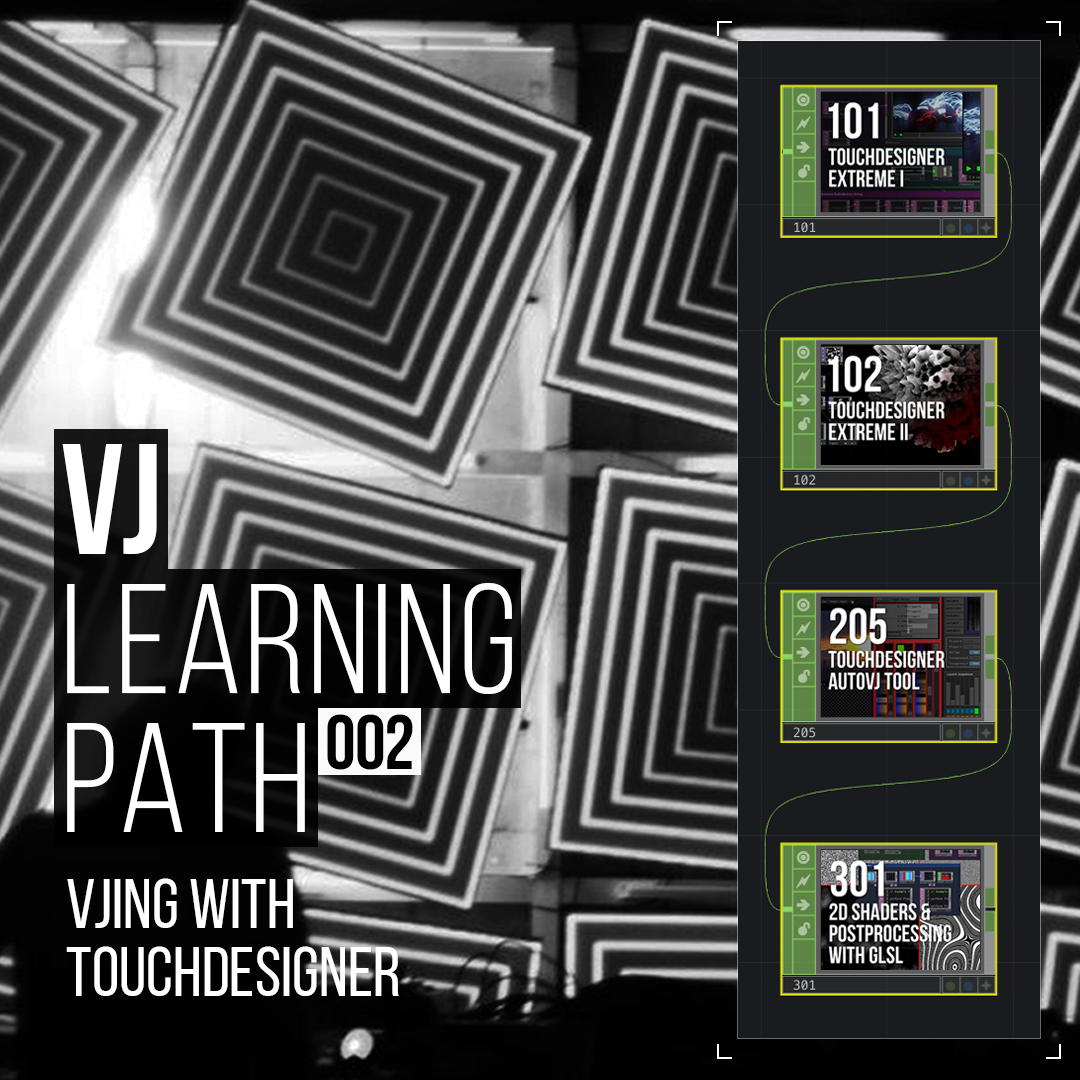 TouchDesigner · Ableton Live +2VJing Path
43 h video · €1,195
Think procedural
11All courseshou2touch.com ↑hou2touch 2025 (c)
go up ^ License Agreement go up ^ License Agreement RU Privacy Policy